 language
 English
 Русский
 España
 Français
 عربي
عربي
 中文版
中文版
2026 Panama Canal Situation: Opportunities, Challenges, and Strategies for Plastic Thermoforming Machine Exports

Introduction
As global manufacturing trade continues to deepen in March 2026, the American markets—specifically Peru, Mexico, and Brazil—have shown robust growth in demand for our specialized equipment. However, the Panama Canal, the strategic bottleneck connecting the Pacific and Atlantic Oceans, is experiencing fluctuations in capacity and transit policies. For a manufacturer of high-precision, large-scale plastic thermoforming machines, analyzing these shifts is essential to safeguarding our export delivery and supply chain resilience.
I. Current Status: Shifting from "Water Crisis" to "Structural Congestion"
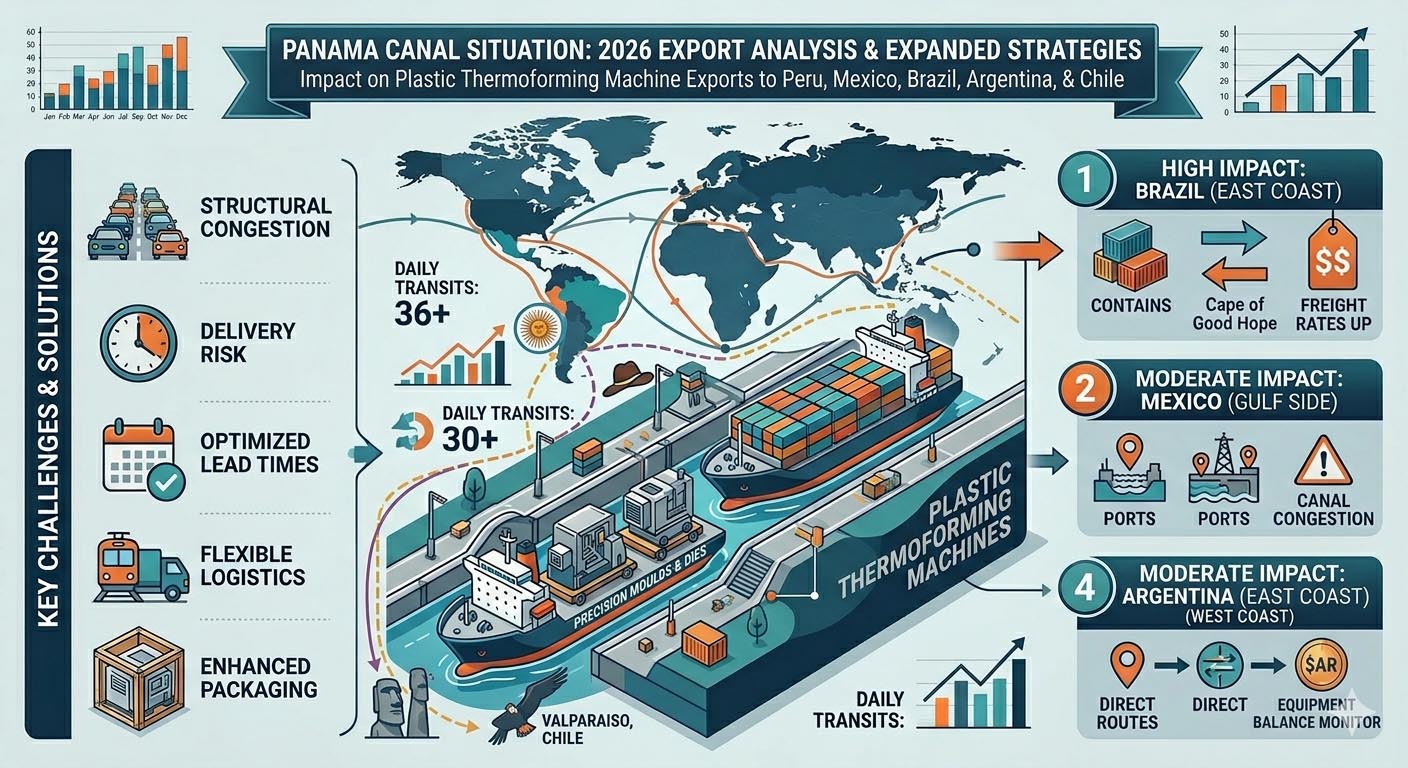
Looking back at the past two years, the Panama Canal struggled significantly with water level declines due to extreme drought. As of Q1 2026, while water levels in Gatun Lake have largely recovered to safe thresholds and daily transits have returned to a normal volume of over 36 vessels, the "ripple effect" persists.
The current logistics pressure stems primarily from Global Route Restructuring. Due to instability in other global shipping lanes, a surge of energy and bulk commodity vessels—which previously did not use the Panama Canal—are now flooding the route, competing for "slots" with container ships. This structural congestion means that non-reserved vessels face significantly longer wait times. For an exporter like us, who relies on strict shipping schedules for heavy machinery, this increases the risk of unpredictable delivery windows.
II. Impact Analysis by Core Market
1.Brazil (High Impact): Ports on the East Coast of Brazil are critical destinations for our thermoforming machines. Currently, because the auction prices for transit priority remain high, some shipping lines have begun diverting vessels around the Cape of Good Hope. This not only extends the voyage by 15 to 20 days but also directly drives up ocean freight rates.
2.Peru & West Coast Mexico (Low Impact): Shipments to Callao (Peru) or Manzanillo (Mexico) typically utilize direct Pacific routes that bypass the Canal. However, we must remain vigilant regarding "equipment imbalances." Congestion at the Canal slows down the return of empty containers, which may lead to localized container shortages or spikes in drayage costs.
3.East Coast Mexico (Moderate Impact): Cargo destined for the Gulf side of Mexico is fully exposed to Canal congestion risks. We recommend closely monitoring the port rotation sequences of selected carriers.
III. Strategic Recommendations for the Company and Clients
To navigate this volatile shipping environment, we propose action across three dimensions:
1.Flexible Logistics Planning: Prioritize carriers that hold Confirmed Booking Slots with the Panama Canal Authority (ACP). Avoid "extra loaders" or low-cost carriers that lack guaranteed transit windows. For urgent orders, evaluate multimodal options such as "US West Coast Discharge + Land Transit" or "Panama Canal Railway" transshipment.
2.Optimization of Lead Times: We advise clients to lock in orders 3–4 weeks earlier than usual to buffer against potential sailing delays. Furthermore, commercial contracts should clearly define mechanisms for ocean freight fluctuations and demurrage cost-sharing to increase contract resilience.
3.Enhanced Packaging and Protection: Longer voyages and potential extra handling during transshipment place higher demands on the moisture-proofing and shock-resistance of precision thermoforming components. We should reinforce vacuum sealing and utilize heavy-duty reinforced wooden crating at the factory stage.
Conclusion
While the situation at the Panama Canal remains fluid, it serves as a "stress test" for our supply chain management. Through precise market forecasting and agile logistics scheduling, we will not only ensure the safe and timely delivery of our equipment but also demonstrate the high-efficiency service value of Chinese high-end manufacturing during these challenging times.